

In the commercial transportation and heavy machinery industries, operational environment demands are uncompromising. Standard in-cab displays frequently fail when subjected to intense moisture, dust, and wash-down cycles. To maintain continuous situational awareness and safeguard fleet operations, industrial-grade waterproof monitors have transitioned from an optional upgrade to a baseline operational requirement.
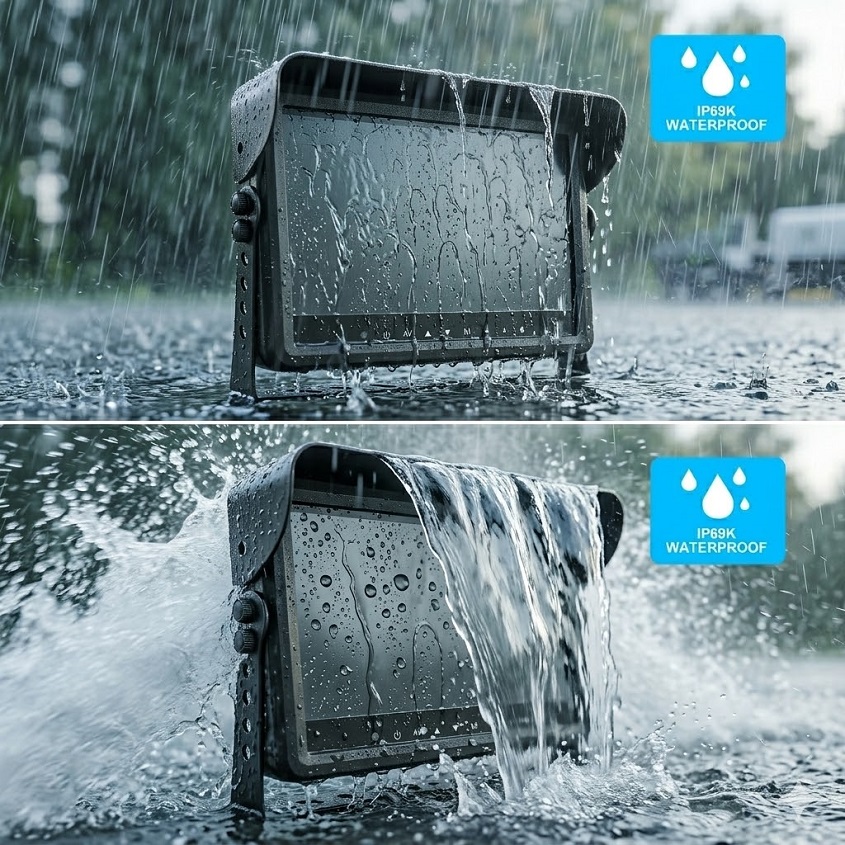
As a professional vehicle safety hardware manufacturer, Standtop engineering emphasizes real-world durability over superficial marketing terminology. This comprehensive technical guide analyzes the specific application scenarios, structural roles, and material configurations that define premium on-vehicle waterproof displays.
Unlike standard automotive monitors limited to climate-controlled passenger cabins, rugged waterproof monitors are built to survive open-air exposure, persistent vibrations, and high-pressure washing. Key commercial platforms include:
Agricultural & Forestry Machinery: Tractors, combine harvesters, and logging equipment operate continuously in open environments without enclosed cabs. Monitors mounted on these platforms must withstand unpredictable weather changes, torrential rain, and extreme dust accumulation during harvesting periods without experiencing internal fogging or circuit shorts.
Construction & Engineering Vehicles: Excavators, bulldozers, rollers, and dump trucks face severe vibration and heavy airborne particulate matter. Because these vehicles are cleaned using high-pressure water jets at the end of shifts, any monitoring display installed in semi-open or exposed locations must maintain a true hermetic seal to prevent high-velocity water ingress.
Port Logistics & Material Handling: Forklifts and reach stackers operating in maritime port terminals face a unique dual threat: constant outdoor exposure and high-salinity marine environments. Standard electronics quickly corrode under these conditions, leading to display degradation or sudden failures. Specialized compact waterproof monitors deliver heavy-duty resilience without taking up excessive operational space inside the operator's line of sight.
Sanitation & Waste Management Trucks: Garbage trucks, street sweepers, and vacuum tankers operate in high-humidity, high-contamination zones. The safety hardware must withstand daily chemical wash-downs, high-pressure steam cleaning, and acidic or corrosive residues typical of waste collection environments.
A ruggedized waterproof monitor serves as the central visual hub for critical vehicle telemetry and surrounding safety feeds. Its primary functional contributions include:
Continuous All-Weather Operations: Eliminates vehicle downtime caused by display hardware failures during severe weather. Whether operating in a tropical monsoon or a freezing northern winter, the display remains operational, keeping the fleet moving safely.
High-Definition Real-Time Vision: Paired with heavy-duty wired cameras, these monitors process direct video feeds with zero latency. Drivers receive instant, crystal-clear visual confirmation of rear, front, and side hazards, which is critical when maneuvering heavy equipment in cramped spaces.
Enhanced Space Efficiency: Designed to balance extreme protection with space constraints. They offer robust environmental defense without requiring bulky external protective enclosures, ensuring the operator’s field of vision remains unobstructed.
Mitigating Corrosive Risk: Protects internal electronics against chemical detergents, salt spray, and industrial pollutants, dramatically extending the operating life cycle of the vehicle’s safety deployment and maximizing ROI.
Technical Insight (Multi-Channel Scalability): While standard vehicle installations rely heavily on standard 4-channel view configurations, professional-grade waterproof monitors support flexible display variations. They feature robust video input structures capable of expanding to multi-channel configurations or high-capacity storage integration options based on customized fleet demands.
The reliability of a waterproof monitor depends entirely on its materials and structural architecture. True IP68 or IP69K protection ratings cannot be achieved with standard consumer plastics. Premium engineering requires specific material choices:
Heavy-Duty Die-Cast Aluminum Alloy Enclosures: The primary housing structure must resist both physical impacts and thermal stress. Using die-cast aluminum provides exceptional structural rigidity to survive heavy mechanical shocks. Additionally, aluminum acts as a highly efficient natural heat sink, dissipating internal thermal buildup to ensure stable electronic processing even under direct sunlight in high-temperature environments.
Chemically Hardened Cover Glass & Optical Bonding: The front glass layer must resist scratches, rock impacts, and pressure washing. Premium waterproof displays use high-transmittance, chemically strengthened glass panels. Furthermore, advanced Optical Bonding technology fills the air gap between the LCD panel and the outer glass with an industrial-grade optical resin. This eliminates internal moisture condensation (fogging) and significantly reduces solar glare, maximizing outdoor readability.
High-Resilience Silicone Gaskets & Specialized Cable Seals: The mating surfaces between the front bezel, glass, and rear housing are sealed using custom-molded, anti-aging silicone gaskets that retain their elasticity across a wide temperature spectrum. Cable entry points utilize specialized over-molded strain reliefs and waterproof aviation connectors to block moisture from wicking along the wiring harness into the internal PCB.
| Engineering Metric | Standard Specification Reference |
| Ingress Protection Rating | IP68 / IP69K Certified (High-Pressure Steam Jet Resistant) |
| Enclosure Material | Rugged Die-Cast Aluminum Alloy Outer Shell |
| Display Enhancement | Optical Bonding Technology (Anti-Fogging & Anti-Glare) |
| Connector Type | 4-Pin Waterproof Aviation Screw-Lock Connectors |
| Operational Temperature | -30°C to +70°C Stable Performance Range |
For international B2B distributors, system integrators, and heavy equipment operators, selecting the right monitor involves looking past basic marketing claims. A true vehicle safety solution must withstand real-world industrial environments. Investing in high-protection, compact, and material-optimized waterproof monitors directly lowers equipment failure rates, minimizes liability risks, and ensures reliable operation across any fleet application.
Address:Rm 212, Zhongzheng Sci-Tech Innovation Park, No. 90-2 Xintang Road,Fuhai, Baoan District,Shenzhen,518103,China
© 2010-2026 All Rights Reserved




 Wechat

 WhatsApp

 Email
Email

 +86-755-27322079